What is kirtan? Devotional singing and bhakti yoga
A clear introduction to kirtan: how it is practised, its relationship to bhakti yoga, and the divine names people may sing.
Published
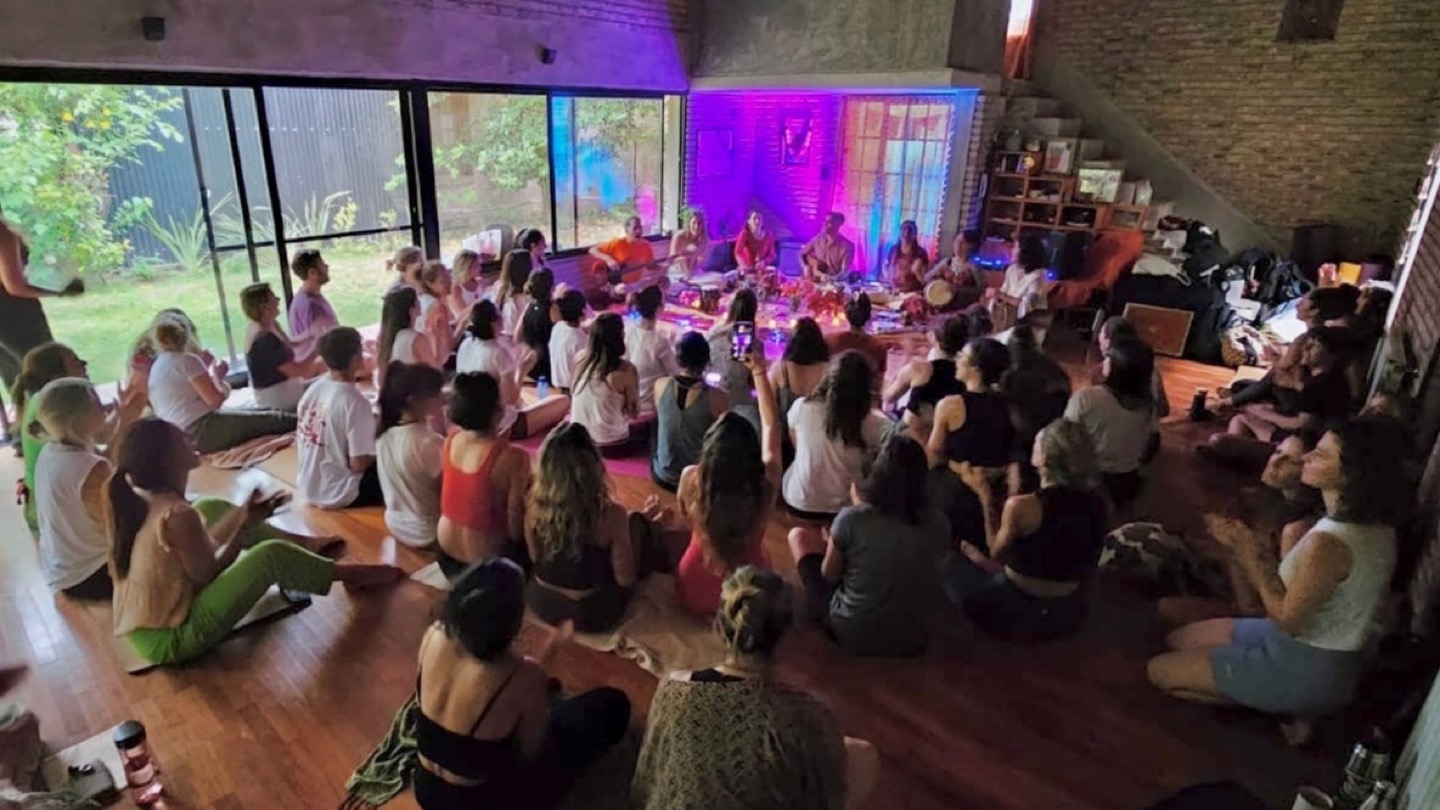
Kirtan is a devotional, participatory practice that brings together singing, listening and repetition. Depending on the tradition and setting, it may include divine names and qualities, sacred stories or mantras.
Although musicians are often present, kirtan does not work like a conventional concert. The invitation is not only to listen to the person at the front, but to share in the singing in whatever way each person can: responding, keeping time with the hands or remaining silent.
What happens in a kirtan gathering?
Many contemporary gatherings use a call-and-response pattern. A lead voice sings a short phrase and the group repeats it. The melody may continue for several cycles, change in intensity and give way to moments of silence.
Harmonium, percussion, guitar or other instruments may accompany the voices. However, there is no single format that defines all kirtan: some expressions are intimate and contemplative; others are more rhythmic and expansive.
Repetition makes it possible to learn without prior preparation. First you listen; then, if the impulse arises, you respond. You do not need to know the melody from the beginning or sing in any particular way.
Kirtan and bhakti yoga
Bhakti means devotion and can also be understood as a loving participation or relationship with the divine. Bhakti yoga brings together diverse paths and practices, including singing, listening, remembrance, service, contemplation and surrender.
Kirtan is one expression of bhakti, not the whole of bhakti yoga. Its musical dimension helps people share the practice, but its roots are devotional: what is sung matters, as do the attention and intention with which people take part.
Traditional texts predating modern forms of kirtan already mention singing and praise in devotional life. The Bhāgavata Purāṇa, for example, lists śravaṇam—listening—and kīrtanam—praising or singing—among several forms of bhakti. The Bhagavad Gītā also connects constant praise with devotion, although that passage alone does not describe a contemporary musical session.
Kirtan, sankirtan and bhajan: a simple distinction
These terms are related and their uses may overlap. As a starting point:
| Term | Practical meaning |
|---|---|
| Kirtan | Devotional praise, recitation or singing. Many contemporary gatherings include repetition and group participation. |
| Sankirtan | Collective or congregational kirtan, especially in Gaudiya contexts. It also appears as saṅkīrtana or sankirtana. |
| Bhajan | A devotional song or practice that may take a freer form and is not always organised as call-and-response. |
This distinction is a useful orientation, not a rigid boundary. The words vary in scope across regions, communities and lineages.
Who is sung to in kirtan?
There is no single answer. Different repertoires may include names of Krishna and Radha, Shiva, Ganesha, the Divine Mother and other forms of the divine.
Krishna and Radha have a particularly strong presence in Vaishnava traditions. That does not mean all kirtan is limited to them or that every community understands the practice in the same way.
Names often appear in short phrases or mantras that a group can learn through repetition. One example is Om Namah Shivaya, dedicated to Shiva. To learn about its translation and context, read our guide to the meaning of Om Namah Shivaya.
Chaitanya Mahaprabhu
Chaitanya Mahaprabhu was a sixteenth-century Bengali saint and teacher, central to Gaudiya Vaishnavism. In that tradition, he promoted and made nāma-saṅkīrtana—the congregational chanting of divine names, especially the names of Krishna—central.
His influence was decisive in the development of Gaudiya sankirtan, but he did not invent all kirtan. The term and devotional practices associated with singing have earlier roots and diverse expressions across the geographies and traditions of India.
How to approach kirtan for the first time
You do not need to know Sanskrit, understand every translation or have musical experience. You can take part in a simple way:
- Listen to one full cycle before joining in.
- Repeat the phrase once it feels familiar.
- If you do not want to sing, stay present and listen.
- Let the silences be part of the gathering too.
You also do not need to adopt a single belief to approach a Mantra Shakti gathering. Our invitation is welcoming: everyone can listen, sing and learn about the shared names without worrying about “getting it wrong”.
How Mantra Shakti shares kirtan
Mantra Shakti is a contemporary offering broadly inspired by bhakti. We are not the official expression of a specific lineage, nor do we seek to speak on behalf of all kirtan traditions.
We share mantras with voices, harmonium, percussion and other instruments, taking care to preserve the participatory nature of the gathering. There may be intimate moments, more expansive ones and pauses in which the singing returns to silence.
This flexibility allows kirtan to meet shalas, retreats, festivals and cultural spaces. The practice offers a shared framework; each person names what they experience from their own perspective.
Sources and recommended reading
- International Vaishnava Studies Journal — study of forms and meanings of kirtan
- Oxford Bibliographies — Bhakti
- Bhāgavata Purāṇa 7.5.23–24 — translation and commentary from a Gaudiya tradition
- Gita Supersite, IIT Kanpur — Bhagavad Gītā 9.14
- Oxford Academic — critical biography of Chaitanya
- Yale University — Bhakti and the Indian Ocean World
Note: definitions, translations and distinctions between kirtan, sankirtan and bhajan vary across regions, traditions and lineages. This guide offers a general introduction and presents Mantra Shakti as a contemporary offering, not as a doctrinal authority on those traditions.
Continue exploring
Related guide
Om Namah Shivaya: meaning, origins and how to chant Shiva's mantra
Discover what Om Namah Shivaya means, why it is known as the five-syllable mantra, and how to approach its practice through chanting.
Related guide
Who is Shiva? The meaning of the god of transformation
A clear, accessible introduction to Shiva: his relationship with transformation, meditation, cosmic dance and the symbols associated with him.
From text to music
Listen to Mantra Shakti or explore our two formats for organising a gathering.