Who is Ganga Ma? The story of Ganga and her descent to Earth
Learn who Ganga Ma is, why the Ganges is sacred in several Indian traditions, and the story of Bhagiratha and Shiva.
Published
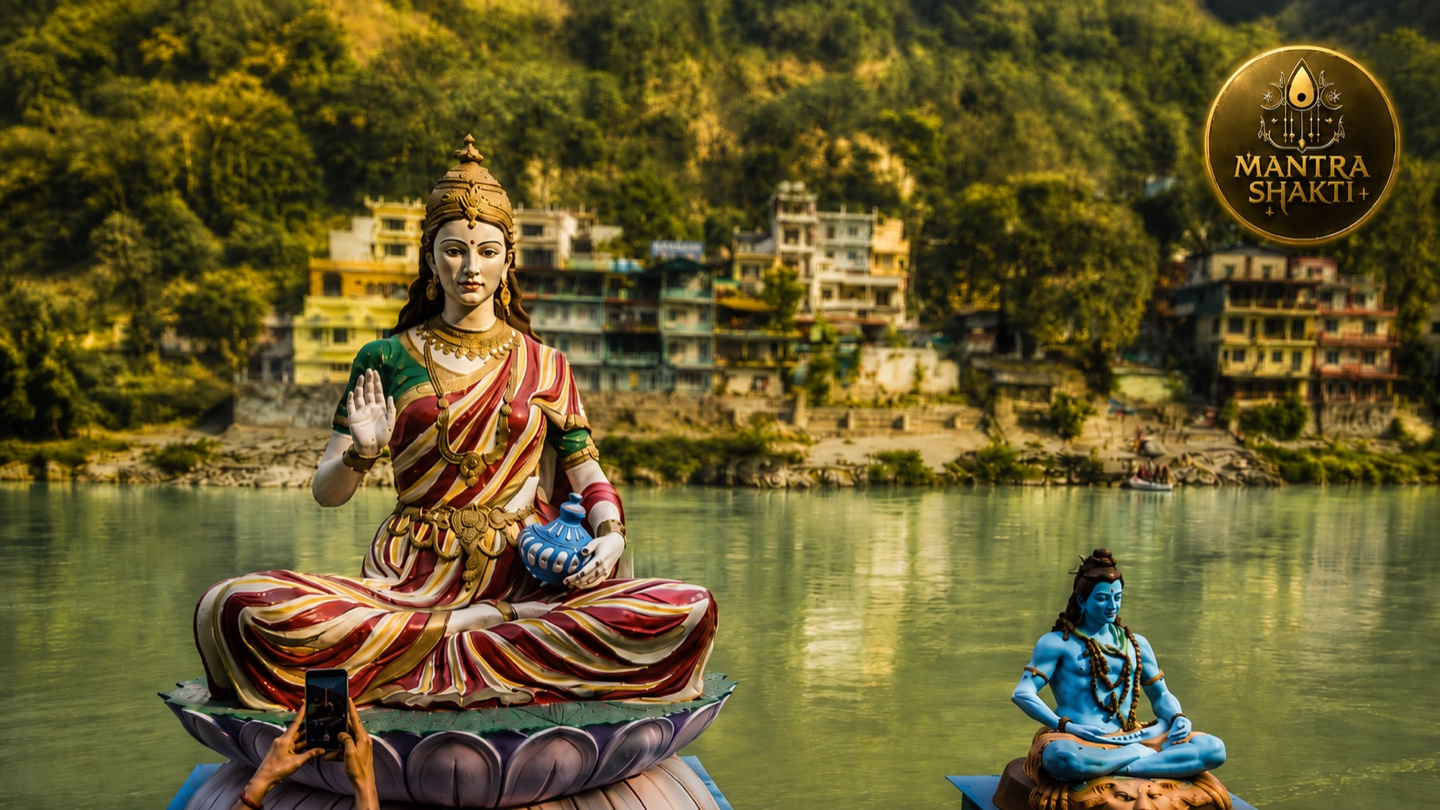
Before singing to Ganga Ma
When we hear a sacred name, learning the story that accompanies it can open a first path of approach. Ganga Ma is one such expression: a reverent, maternal way of naming Ganga before joining the chant.
In several Indian traditions, Ganga can refer both to the Ganges River and to a form of the divine mother. Saying Ganga Ma can express a relationship of respect and maternal closeness to that presence. “Mother Ganga” is an approximate translation, not a single definition shared by every community, region or lineage.
Purification, life and transformation
For many devotees, Ganga is not only a river flowing through the landscape: she is also Ma Ganga, a divine presence associated with life. Calling her “Ma” expresses closeness, respect and care, as in the relationship with a mother. Her significance is therefore understood not only by looking at the river, but also by approaching the relationship people build with its waters.
That relationship is lived in different ways: through ritual bathing, pilgrimages, offerings and the act of bringing a little Ganga water home for devotional practice. Here, purification refers to a religious and ritual meaning: the possibility of approaching renewal, remembrance and transformation.
The bond also extends to ancestors. Varanasi, a sacred city on the banks of Ganga, reveals the depth of this relationship: the river accompanies pilgrimages, offerings and funeral rites in which some families place ashes in the water. Ganga is present in everyday acts of devotion as well as in moments of farewell. For many people, her waters connect life, memory and continuity with those who came before.
The traditional story of Ganga’s descent
In Vālmīki’s Rāmāyaṇa, Bhagiratha is a king in the line of Sagara. Bhagiratha inherits more than a kingdom: he inherits the task of bringing Ganga to his ancestors.
To understand why this task mattered so much, we must return to King Sagara. His sixty thousand sons had gone in search of the horse intended for a ritual sacrifice. When they found it beside Kapila, a sage of immense power, they believed he had stolen it. In their anger, they accused him and rushed at him with weapons. Kapila answered with a single exclamation, “hum”, and the force of his anger reduced them to ashes.
Some time later, Amshuman, Sagara’s grandson, reached the place and found his ancestors’ ashes. Overcome with grief, he wept for them. He wanted to offer them the ritual water they needed, but there was no water there with which to do so. Garuda then told him that Ganga’s waters had to reach the ashes for their liberation to be completed.
From that moment, bringing Ganga became more than a wish: it became a family responsibility, a way of remembering those left behind and not abandoning their fate. This helps explain why the river’s descent lies at the heart of the story: Ganga brings together the efforts of the living, the memory of the dead and the hope that a promise kept across generations may finally find rest.
The wish then passes from one generation to the next. Amshuman tries to bring Ganga; later, his son Dileepa also seeks a way to fulfil the task, but neither sees it completed. When Bhagiratha inherits the kingdom, he also receives that unfulfilled promise. We can read this continuity as a powerful image: sometimes hope does not come from an immediate answer, but from choosing to care for a promise until someone can open the way.
King Bhagiratha therefore undertakes a practice of tapas—a sustained discipline of devotion—to bring Ganga down to Earth. His purpose is tied to the liberation of his ancestors.
Brahmā warns that Earth could not withstand the force of the fall and that Shiva must receive it. Bhagiratha undertakes tapas again, this time to ask for Shiva’s help. He perseveres for a year in a posture of concentration and prayer, until Shiva responds and agrees to receive the descent on his head.
Bhagiratha’s tapas
In this story, tapas describes the ritual and devotional effort Bhagiratha sustains in pursuit of his purpose.
The descent does not happen as an instant solution. Bhagiratha must persevere, ask for Shiva’s intervention and continue on his path until Ganga can flow onward.
Shiva receives and channels the fall
When Ganga descends, she falls into Shiva’s matted locks, his jaṭās. Shiva holds her there and, after Bhagiratha resumes his practice of tapas, releases her so she can continue her journey.
It is therefore more precise to speak of receiving, containing and channelling the force of the descent than of “taming” Ganga. The image brings together the power of water and Shiva’s ability to give it a course without reducing it to a force that must be defeated.
If you would like another way into Shiva’s figure and symbols, read our guide to who Shiva is.
Listening to “Jay Ganga Ma” with this context
With this background, you can approach the Jay Ganga Ma live session on YouTube in whatever way feels honest to you. You can sing, listen attentively or remain silent; you do not need to adopt one interpretation or prove a particular experience.
If you would like to keep exploring the relationship between Shiva, mantras and singing, you can also read about the meaning of Om Namah Shivaya.
Watch the Jay Ganga Ma live session
If you would like to bring this context into the chant, you can watch the full live session here:
Continue exploring
Related guide
Who is Shiva? The meaning of the god of transformation
A clear, accessible introduction to Shiva: his relationship with transformation, meditation, cosmic dance and the symbols associated with him.
Related guide
Om Namah Shivaya: meaning, origins and how to chant Shiva's mantra
Discover what Om Namah Shivaya means, why it is known as the five-syllable mantra, and how to approach its practice through chanting.
From text to music
Listen to Mantra Shakti or explore our two formats for organising a gathering.